

Author: Jeff Leong, PhD Candidate in International Law and Regional Governance, Beijing Foreign Studies University (2023-2027); Chair, LAWASIA Corporate, Securities and Investment Law Committee; Co-Chair, LAWASIA Belt and Road Initiative Committee; and Senior Partner, Jeff Leong Poon & Wong (Malaysia)
Introduction
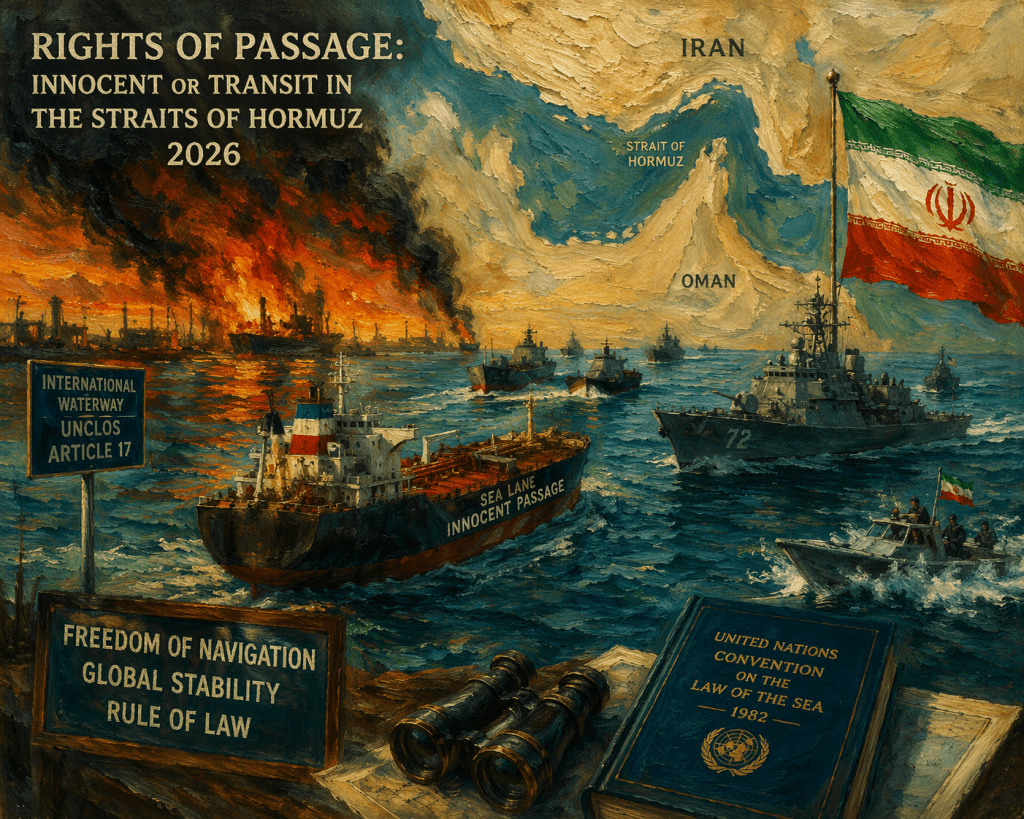
The 2026 crisis in the Strait of Hormuz was not just another shipping disruption. It was a live test of whether international law can still protect the world’s key sea lanes when a coastal State decides to turn legal rules into political leverage.
A narrow strait with global consequences
The Strait of Hormuz is a natural bottleneck. Through this narrow channel, tankers and cargo ships carry oil, gas, fertiliser and goods that support economies on every continent. When traffic slows, prices rise; when traffic stops, entire supply chains shake.
In March 2026, that is exactly what happened. As tensions escalated between Iran, the United States and Israel, Iran’s Revolutionary Guard Corps (IRGC) warned ships to stay out of Hormuz, reportedly laid mines, and attacked or seized several vessels. Major shipping lines pulled back. Tanker and container traffic fell dramatically and, for a period, almost disappeared as ships chose to wait outside the Gulf rather than risk passage.
UNCTAD and other international bodies quickly warned that the disruption threatened not only energy markets but also food security, because much of the world’s fertiliser and grain shipments move through this route. A legal problem had become an economic and humanitarian concern.
What the law actually says
International law, on its face, is clearer than the chaos suggested. The UN Convention on the Law of the Sea (UNCLOS) treats straits like Hormuz as “straits used for international navigation”. That status triggers a special regime called “transit passage”.
Transit passage goes beyond ordinary “innocent passage” in the territorial sea. It allows all ships and aircraft to move continuously and quickly through the strait. Coastal States can adopt safety and environmental rules, but they cannot suspend transit passage or block particular countries’ vessels simply because of politics. They also cannot charge general tolls for using the strait; charges are limited to specific services like pilotage or harbour facilities.
Even though Iran has signed but not ratified UNCLOS, many States and experts consider the transit‑passage regime to reflect customary international law – in other words, a rule that binds all States because it is widely accepted and practised. Older case law, such as the Corfu Channel judgment, supports the idea that international straits must remain open in peacetime so long as ships themselves act lawfully.
Iran’s challenge: power versus principle
Iran has a different view. For years it has argued that, as a non‑party to UNCLOS, it is not bound by transit passage. It says only innocent passage applies in its territorial sea, including in Hormuz, and that it can impose stricter controls for security reasons.
During the 2026 crisis, this position moved from theory to action. By issuing warnings, deploying mines and attacking vessels, Iran effectively closed the strait to many users, especially those linked to States it deemed hostile. At the same time, reports emerged that Tehran was drafting laws to impose tolls on ships transiting Hormuz and to introduce a “vetting system” to decide which vessels could pass and on what terms.
In plain terms, Iran tried to turn a recognised right of passage into a paid, politically conditioned privilege. Legal commentators across multiple jurisdictions described such tolls as fundamentally inconsistent with UNCLOS and with the broader law of the sea. Many labelled the idea of politically targeted tolls as a form of “modern piracy” when applied to an international strait.
The strategic concern is obvious. If one coastal State can monetise and politicise a chokepoint with few consequences, others may be tempted to copy the model in other straits – from Malacca to Bab el‑Mandeb and beyond.
The UN response: clear principles, limited enforcement
The United Nations Security Council took up the issue. Draft resolutions circulated that would have authorised States to use “all necessary means” to secure freedom of navigation in and around Hormuz. That language, familiar from previous Chapter VII mandates, would have given a strong legal basis for naval operations to protect transit passage.
However, political divisions among the permanent members led to a more cautious outcome. The final text reaffirmed the importance of freedom of navigation and referred to States’ rights and obligations under UNCLOS, but it stopped short of an explicit, robust enforcement mandate. The Council recognised that closing or restricting Hormuz in this way was unacceptable, yet it hesitated to fully back that judgment with coercive tools.
This mixed response sends a complicated signal. On one hand, it strengthens the legal narrative that transit passage in Hormuz is protected and that Iran’s actions violated established norms. On the other hand, it highlights the gap between declaring rules and enforcing them when powerful States disagree or fear escalation.
The reality at sea: when rights cannot safely be used
For shipowners, captains and insurers, the situation was more straightforward: the strait was too dangerous. Once attacks began and official warnings spread, war‑risk premiums jumped. Masters faced not only physical threats to their crews but also contractual and liability issues if they chose to sail through an area widely viewed as a war zone.
In legal theory, vessels still had a right to transit Hormuz. In practice, most could not exercise that right without unacceptable risk. Many rerouted or delayed. Legal commentary started to focus less on abstract rights and more on doctrines like force majeure, frustration of contracts and deviation.
This exposes a key weakness in the system. A coastal State that is willing to use force can, at least temporarily, defeat a clear legal rule simply by making compliance too dangerous. If the international reaction is limited to statements and rerouting, the unlawful behaviour may become a recurring pattern rather than a one‑off exception.
Why this matters beyond the Gulf
The Hormuz crisis also pushed the law of the sea into wider debates about economic security. Keeping international straits open is not just a naval issue; it is central to energy policy, food security and global development. UNCTAD’s warnings and the knock‑on effects on prices and supply chains underline that point.
For many trading nations, especially those that depend heavily on imported energy and food, the principle at stake is simple: key chokepoints must remain open on equal terms to all. Their economies cannot afford a world in which access to straits depends on political bargaining with coastal States or on paying ad hoc tolls to whichever power dominates the shoreline at a given moment.
That explains why some governments took a strong public line during the crisis. Officials from heavily trade‑dependent States emphasised that navigation rights in international straits are not up for negotiation or sale. Their concern is not only Hormuz itself, but the precedent any compromise might set for other waterways they rely on.
What the 2026 crisis means for international law
The 2026 Strait of Hormuz crisis leaves international law with both a warning and an opportunity.
The warning is clear: rules, even well‑settled ones like transit passage, can be challenged by determined coastal States. Without a credible willingness to respond collectively – through diplomacy, economic pressure and, if necessary, protective operations – those rules risk being eroded in practice.
The opportunity lies in the strong, near‑universal reaction that Iran’s actions provoked among legal experts, international bodies and many governments. The crisis has prompted a renewed, public affirmation that closing an international strait, imposing political tolls or selectively denying passage based on alignment is unlawful. It has drawn attention to the need for better contingency planning, more resilient supply chains, and clearer commitments to defend navigation rights.
Ultimately, Hormuz 2026 is a reminder that the law of the sea is not self‑executing. Transit passage and freedom of navigation are only as strong as the political will to stand behind them when they come under pressure. If States treat the crisis as a wake‑up call, not a one‑off anomaly, it can reinforce rather than weaken the legal order on which global trade still depends.
This commentary draws on a longer academic article I am writing on a comparative study of innocent and transit passage in the Straits of Malacca and Hormuz, using the 2026 Hormuz crisis to test the resilience of UNCLOS straits regimes in practice.
Keywords: UNCLOS; transit passage; Strait of Hormuz; Strait of Malacca; freedom of navigation; maritime security; international law; regional governance.
Further reading
• UNCTAD – Strait of Hormuz disruptions: Implications for global trade and development (2026)
• Bertina Kudrin, “The Strait of Hormuz and the Limits of Maritime Law” – Lawfare (2026)
• ASIL Insight – “Transit Passage Rights in the Strait of Hormuz and Iran’s Threats to Block Passage” (2012)
• “The Legal Regime of the Strait of Hormuz and Attacks Against Oil Tankers” – Journal of Maritime Law and Commerce (2022)
• Ras Al Khaimah Center – “The International Law of the Sea, the Straits of Hormuz and Regional Security” (2025)
• NUS MEI Perspectives – “Stress‑Test the Vital Hormuz–Malacca Artery Before It Breaks” (2026)
• Derasat, “The Strait of Hormuz: A Legal Perspective on Maritime Security” (2026)
• Hill Dickinson, “Strait of Hormuz Closure – Legal Implications” (2026)
• QIL QDI dossier – “The Strait of Hormuz” (Questions of International Law)
• Majdin et al, “The Strait of Malacca and Strait of Hormuz: A Brief Historical Review” (2023)
AI Disclosure Statement
This commentary was prepared with AI-assisted edits, research and source verification. All substantive analysis, original conceptual frameworks, strategic arguments, and editorial judgments remain the author’s. The author accepts full responsibility for the accuracy of all claims and the integrity of all citations. This disclosure complies with emerging academic publishing transparency standards.

Contact us
Address :
B-11-8, Level11, Megan Avenue II, Jalan Yap Kwan Seng, 50450 Kuala Lumpur, Malaysia
Phone : (603) 2203 3388
Fax : (603) 2203 3399
Website :

 JLPW NEEDLAWYER BLOG