

Abstract
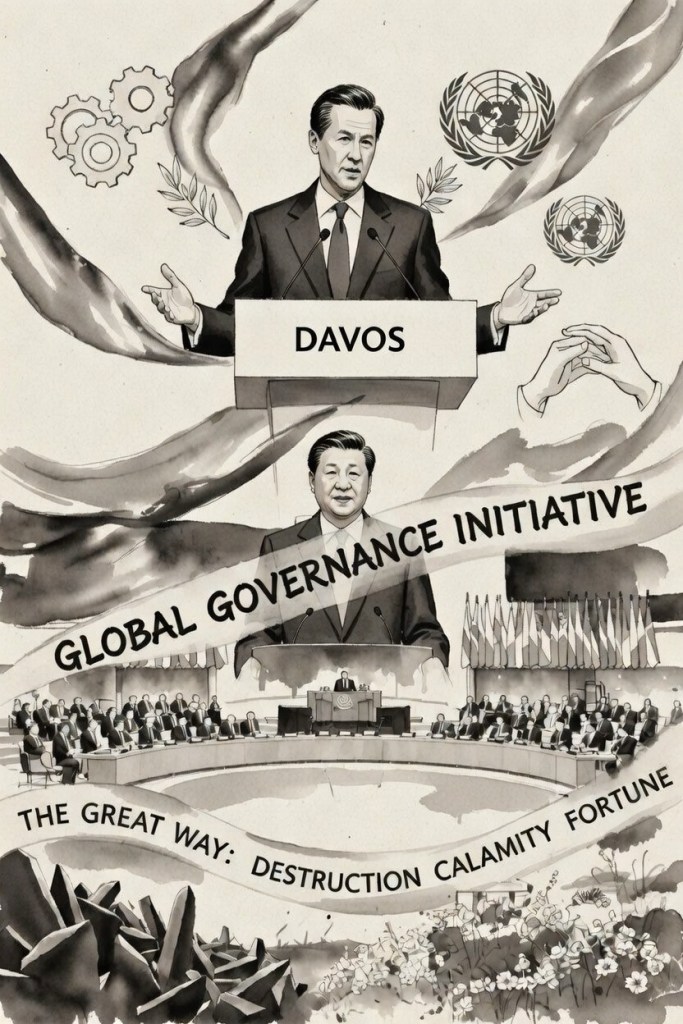
The contemporary international system faces profound disruption, characterised by successive crises that have eroded the post-Cold War liberal consensus. Canadian Prime Minister Mark Carney’s January 2026 address to the World Economic Forum in Davos framed this era as a “rupture, not a transition,” urging middle powers to adopt principled pragmatism in navigating great-power competition and weakened norms.¹ Chinese Premier Li Qiang’s speech to the United Nations General Assembly on 26 September 2025 offered a complementary vision of historical inevitability, invoking the “Great Way” (Dàdào) as an unstoppable tide toward peace, development, and multilateralism.² This article examines the philosophical and practical convergence between Carney’s call for values-based realism and China’s Global Governance Initiative (GGI), proposed by President Xi Jinping in September 2025, as part of a suite of four global initiatives. Drawing on classical Chinese thought—including Confucius’s vision of Great Harmony (Dàtóng) and Taoist principles from the Huainanzi—the analysis argues that cross-civilisational learning provides the most viable path to reforming global governance amid climate change, pandemics, trade conflicts, and physical wars.
Introduction
The international order is undergoing fundamental change. Crises in finance, health, energy, and geopolitics have exposed the vulnerabilities and limits of the Western led international rules-based order.³ Mark Carney, in his Davos address, described this as a rupture: the end of a “pleasant fiction” and the onset of a “harsh reality” where great-power geopolitics operates without constraints.⁴ He advocated principled pragmatism—adherence to sovereignty, territorial integrity, non-aggression under the UN Charter, and human rights—while recognising incremental progress, divergent interests, and the need for flexible, issue-specific coalitions among middle powers.⁵
In parallel, Chinese Premier Li Qiang asserted at the UN that “the tide of history surges forward, and the Great Way remains smooth and steadfast.”⁶ This phrase, rooted in Daoist and Confucian philosophy, signals confidence that temporary disruptions cannot reverse the trajectory toward cooperation and multipolarity. Li linked this vision to China’s four interconnected initiatives: the Global Development Initiative (GDI, 2021), Global Security Initiative (GSI, 2022), Global Civilization Initiative (GCI, 2023), and Global Governance Initiative (GGI, 2025).⁷ The GGI, with its five core concepts—sovereign equality, international rule of law, genuine multilateralism, people-centred approach, and real results—seeks to reform rather than replace the existing system, prioritising equity for the Global South.⁸
The Philosophical Foundations: Great Way and Great Harmony
The “Great Way” (大道, Dàdào) derives from classical Chinese philosophy, representing the natural, harmonious path that transforms chaos into order.⁹ Li Qiang’s invocation frames China’s initiatives as alignment with this inexorable historical current, favouring collaboration over confrontation.¹⁰
This vision echoes Confucius’s “Chapter of Great Harmony” (大同, Dàtóng) from the Book of Rites, inscribed at the foot of the Confucius statue near the United Nations in New York’s Chinatown:
When the great principle prevails, the world is a commonwealth in which rulers are selected according to their wisdom and ability. Mutual confidence is promoted and good neighbourliness cultivated. Hence, men do not regard as parents only their own parents nor do they treat as children only their own children. Provision is secured for the aged till death, employment for the able-bodied and the means of growing up for the young. Helpless widows and widowers, orphans and the lonely, as well as the sick and the disabled, are well cared for. Men have their respective occupations and women their homes. They do not like to see wealth lying idle, yet they do not keep it for their own gratification. They despise indolence, yet they do not use their energies for their own benefit. In this way, selfish schemings are repressed, and robbers, thieves and other lawless men no longer exist and there is no need for people to shut their outer doors. This is the great harmony (Ta Tung).¹¹
The Datong ideal informs the initiatives: the GDI advances shared prosperity and poverty eradication; the GSI and GGI protect the vulnerable through dialogue; the GCI fosters civilisational exchange.¹² Scholars such as Tu Weiming position Confucian harmony as a complementary ethic to Western liberalism, promoting mutual flourishing.¹³
A passage from the Huainanzi—a Han dynasty synthesis of Taoist, Confucian, and Legalist thought—captures the transformative mindset:
By deep knowledge of principle, one can change disturbance into order, change danger into safety, change destruction into survival, change calamity into fortune. By strong action on the Way, one can bring the body to the realm of longevity, bring the mind to the sphere of mystery, bring the world to great peace, and bring tasks to great fulfillment.¹⁴
This bridges metaphysics and strategy: insight into principles enables transformation; resolute action on the Dao yields global peace.¹⁵
Scholarly Context and Convergence
This synthesis of Carney’s post-rupture realism with China’s Great Way vision appears novel, though building on established scholarship. Western analyses link the rupture to China’s initiatives and middle-power responses.¹⁶ Heldt and Park examine China’s reconfiguration of economic governance.¹⁷ Chinese scholars ground the GGI in harmony traditions: Fu Xiaoqiang views it as a proposal for equitable reform;¹⁸ Zhang Yuxin and Ren Lin highlight its principles addressing governance deficits;¹⁹ U Khan traces shared-future concepts to Confucian Datong.²⁰
The GGI’s principles—sovereign equality, rule of law, multilateralism, people-centredness, real results—align with Carney’s call for stability without hegemony.²¹
Conclusion
China’s Global Governance Initiative offers a unifying framework. By deep knowledge of principle—one that changes disturbance into order, danger into safety, destruction into survival, and calamity into fortune—combined with strong action on the Way, the GGI brings the world to great peace and tasks to great fulfillment.
This is precisely what a world wracked by climate change, pandemics, tariff wars, and physical conflicts desperately needs. Learning from the finest elements of Western, Chinese, and other civilisations constitutes the most effective path for reformed, resilient global governance.
#PostRuptureWorldOrder #IR #InternationalLaw #BRICS #GlobalGovernance #Law #Confucius #Daoist #GreatWay #GGI #GCI #GDI #InternationalRelations #UN #UnitedNations #Geopolitics #UNCharter #Multipolar #China
Footnotes
¹ Mark Carney, ‘“Principled and pragmatic: Canada’s path”’ (Speech, World Economic Forum Annual Meeting, Davos, 20 January 2026) https://www.weforum.org/stories/2026/01/davos-2026-special-address-by-mark-carney-prime-minister-of-canada/ accessed 8 March 2026.
² Address by Chinese Premier Li Qiang at the General Debate of the 80th Session of the United Nations General Assembly (Xinhua, 27 September 2025) http://english.scio.gov.cn/m/topnews/2025-09/27/content_118100629.html accessed 8 March 2026.
³ Carney (n 1).
⁴ ibid.
⁵ ibid.
⁶ Li Qiang (n 2).
⁷ Concept Paper on the Global Governance Initiative (Ministry of Foreign Affairs of the People’s Republic of China, 1 September 2025) https://www.fmprc.gov.cn/eng/xw/wjbxw/202509/t20250901_11699912.html accessed 8 March 2026.
⁸ ibid.
⁹ Li Qiang (n 2).
¹⁰ ibid.
¹¹ The Book of Rites (Liji), “Li Yun” chapter (Datong section), inscribed at the Confucius statue, New York Chinatown.
¹² Concept Paper (n 7).
¹³ Tu Weiming, Centrality and Commonality: An Essay on Confucian Religiousness (State University of New York Press 1989).
¹⁴ Thomas Cleary (trans), The Art of War: Complete Text and Commentaries (Shambhala 1988) 3–4 (introduction, linking to Huainanzi strategic thought).
¹⁵ ibid.
¹⁶ ‘After the rupture: Middle powers and the construction of new order’ European Council on Foreign Relations (12 February 2026) https://ecfr.eu/publication/after-the-rupture-middle-powers-and-the-construction-of-new-order/ accessed 8 March 2026.
¹⁷ Eugénia C Heldt and Susan Park, ‘China’s rise and the reconfiguration of global economic governance’ (2025) 32(4) Review of International Political Economy 1.
¹⁸ Fu Xiaoqiang, ‘Global Governance Initiative: China’s Proposal to Build a More Just and Equitable Global Governance System’ (2025) 35(6) China International Relations 4.
¹⁹ Zhang Yuxin and Ren Lin, ‘Understanding Global Governance Initiatives: Historical Context, Core Principles, and Practical Approaches’ (2026) 6(4) China Watch (Institute of World Economics and Politics, Chinese Academy of Social Sciences).
²⁰ U Khan, ‘The Philosophical Thought of Confucius and Mencius, and the Concept of the Community of a Shared Future for Mankind’ (2022) 14(16) Sustainability 9854.
²¹ Concept Paper (n 7); Carney (n 1).
Bibliography
Carney, Mark, ‘“Principled and pragmatic: Canada’s path”’ (Speech, World Economic Forum Annual Meeting, Davos, 20 January 2026) https://www.weforum.org/stories/2026/01/davos-2026-special-address-by-mark-carney-prime-minister-of-canada/ accessed 8 March 2026.
Cleary, Thomas (trans), The Art of War: Complete Text and Commentaries (Shambhala 1988).
Concept Paper on the Global Governance Initiative (Ministry of Foreign Affairs of the People’s Republic of China, 1 September 2025) https://www.fmprc.gov.cn/eng/xw/wjbxw/202509/t20250901_11699912.html accessed 8 March 2026.
Fu Xiaoqiang, ‘Global Governance Initiative: China’s Proposal to Build a More Just and Equitable Global Governance System’ (2025) 35(6) China International Relations 4.
Heldt, Eugénia C and Susan Park, ‘China’s rise and the reconfiguration of global economic governance’ (2025) 32(4) Review of International Political Economy 1.
Khan, U, ‘The Philosophical Thought of Confucius and Mencius, and the Concept of the Community of a Shared Future for Mankind’ (2022) 14(16) Sustainability 9854.
Li Qiang, Address at the General Debate of the 80th Session of the United Nations General Assembly (Xinhua, 27 September 2025) http://english.scio.gov.cn/m/topnews/2025-09/27/content_118100629.html accessed 8 March 2026.
The Book of Rites (Liji), “Li Yun” chapter (Datong section).
Tu Weiming, Centrality and Commonality: An Essay on Confucian Religiousness (State University of New York Press 1989).
Zhang Yuxin and Ren Lin, ‘Understanding Global Governance Initiatives: Historical Context, Core Principles, and Practical Approaches’ (2026) 6(4) China Watch.

Contact us
Address :
B-11-8, Level11, Megan Avenue II, Jalan Yap Kwan Seng, 50450 Kuala Lumpur, Malaysia
Phone : (603) 2203 3388
Fax : (603) 2203 3399
Website :

 JLPW NEEDLAWYER BLOG