

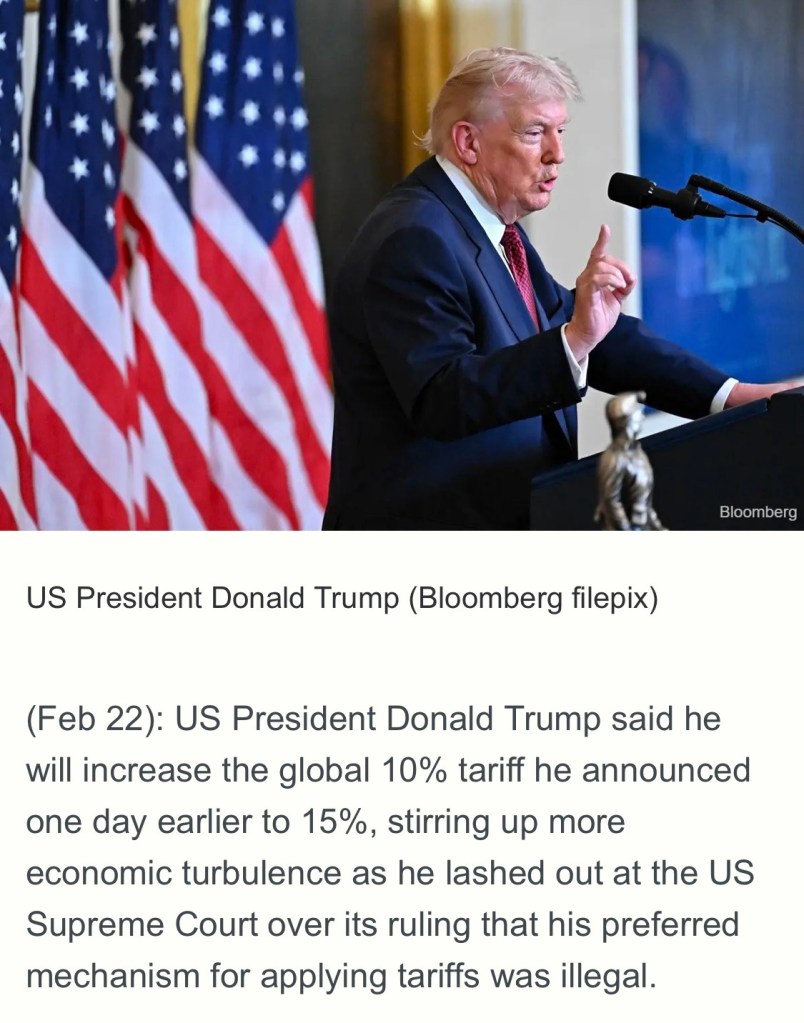
Trump’s mercurial tariff policies—broad, sudden, and frequently shifting—punished global trade in 2025 through massive duties imposed via the International Emergency Economic Powers Act (IEEPA). These included 10–25%+ levies on imports from China, Mexico, Canada, and many others, justified by claims of drug crises, trade deficits, or national security. The approach created chaos: exemptions appeared and vanished, rates changed overnight, and justifications evolved rapidly.
On February 20, 2026, the U.S Supreme Court struck down these IEEPA tariffs in a 6-3 ruling (Learning Resources, Inc. v. Trump and related cases). The Court held that IEEPA does not authorize the president to impose tariffs—tariff power belongs to Congress under the Constitution. This invalidated most of the 2025 regime, potentially triggering $140–175 billion in refunds to importers (though processes remain unclear). Trump quickly responded by revoking the old orders and imposing a new 10% global import duty under Section 122 of the Trade Act of 1974 (a temporary balance-of-payments measure), later raised to 15% in some announcements, with selective exemptions for critical minerals, energy, beef, fruits, and cars.
This environment of erratic, high-impact trade barriers demands a non-rigid response. Dynamic Pragmatism, best exemplified by Bruce Lee’s Jeet Kune Do (JKD) philosophy—”Be like water, my friend”—provides the perfect framework. Lee urged adaptability: “Empty your mind, be formless, shapeless—like water. Water can flow or it can crash.” Instead of fixed styles, be dynamically pragmatic. Absorb what works, discard the useless, and adapt instantly.
Core JKD Principles Applied to Economics Statecraft
1. Absorb what is useful, discard what is not, add what is uniquely your own
Reject dogmatic extremes—neither full retaliation nor complete isolation. Selectively adopt helpful elements from the chaos. Nations and firms absorb pressure by accelerating needed reforms: strengthening supply chains, enforcing IP rules, or subsidizing strategic sectors. China, for example, quietly boosted EU investments and shifted Belt and Road Initiative projects toward high-value digital and renewable areas, turning U.S. restrictions into opportunities for diversification.
2. Economy of motion—no wasted effort
Tit-for-tat tariffs waste resources by raising your own costs and sparking escalation. Redirect energy efficiently. Focus on high-impact areas: services, digital exports, green tech, or premium manufacturing where tariffs hurt least. During 2018–2020 trade tensions, Vietnam and Mexico gained massively from “China+1” shifts without heavy retaliation—capturing investment flows through quiet adaptation rather than confrontation.
3. Formlessness—using no way as way
Hold no fixed ideology. One day pursue WTO compliance; the next sign bilateral deals that skirt barriers. Avoid sacred commitments to “free trade” or “decoupling.” The policy container changes daily (new rate, new exemption, new justification)—your economy flows to fit it. Maintain maximum optionality.
4. Be like water: flow or crash
Flow around obstacles: Use third-country rerouting, minor processing in low-tariff nations (e.g., Vietnam or Mexico) to alter origin rules, currency adjustments, or direct U.S. investment to qualify as “domestic.” When the opponent overreaches—U.S. consumers and firms protest price hikes—apply precise pressure: export controls on rare earths, accelerated standards that exclude U.S. products from third markets, or coordinated BRICS+ fiscal moves. Water erodes rock slowly or crashes powerfully when needed.
5. Intercepting—act first where possible
Anticipate shifts. Build buffers: diversified currency reserves (less USD reliance), alternative payment networks, strategic stockpiles, and fast-response policy teams. BRICS discussions in 2025 already explored rerouting trade in 2–4 years. Act preemptively instead of reacting after each tweet or proclamation.
Practical Playbook for Asia and Beyond
1. Supply-chain jiu-jitsu
Treat every tariff update as market intelligence. Accelerate nearshoring (e.g., final assembly in Mexico for North American rules) or multi-sourcing (“+1” strategies in Malaysia, India, Vietnam, Indonesia).
2. Market reshaping
If the U.S. market hardens, pour into RCEP, ASEAN, EU, Africa, or Latin America. Pool strengths via digital trade pacts or regional standards.
3. Innovation intercept
Tariffs target yesterday’s goods. Invest in tomorrow’s: affordable EVs, batteries, AI manufacturing, biotech. Subsidize R&D over legacy protection.
4. Diplomatic fluidity
Seek quiet U.S. exemptions bilaterally when useful, push plurilateral WTO reforms multilaterally, coordinate South-South ties quietly.
5. Psychological calm
Project resilience publicly. Markets reward adaptability—capital flows to fluid players amid U.S. volatility.
Why This Beats Rigid Alternatives
Fixed retaliation creates mutual damage and political spectacle. WTO cases drag on and face “security” exceptions. Full decoupling harms most economies. Water economics exploits the opponent’s flaws—unpredictability and self-inflicted pain—by enabling low-cost, continuous adaptation.
In this post-February 2026 reality (old IEEPA tariffs gone, new Section 122 duties in play), winners avoid loud confrontation or ideological purity. They stay formless, seize cracks fast, and remain calm when policies shift again.
Dynamic Pragmatism In A Post Rupture World Order
Empty your mind of rigid doctrines.
Be an IR Chameleon.
Use both hard and soft law.
Negotiate, Mediate or Litigate where appropriate.
Be shapeless like water.
Pour into the cup, become the cup.
Flow through tariff walls or crash when the moment demands.
Be water, my friend.
That defines effective economics statecraft against mercurial tariffs.

Contact us
Address :
B-11-8, Level11, Megan Avenue II, Jalan Yap Kwan Seng, 50450 Kuala Lumpur, Malaysia
Phone : (603) 2203 3388
Fax : (603) 2203 3399
Website :

 JLPW NEEDLAWYER BLOG